
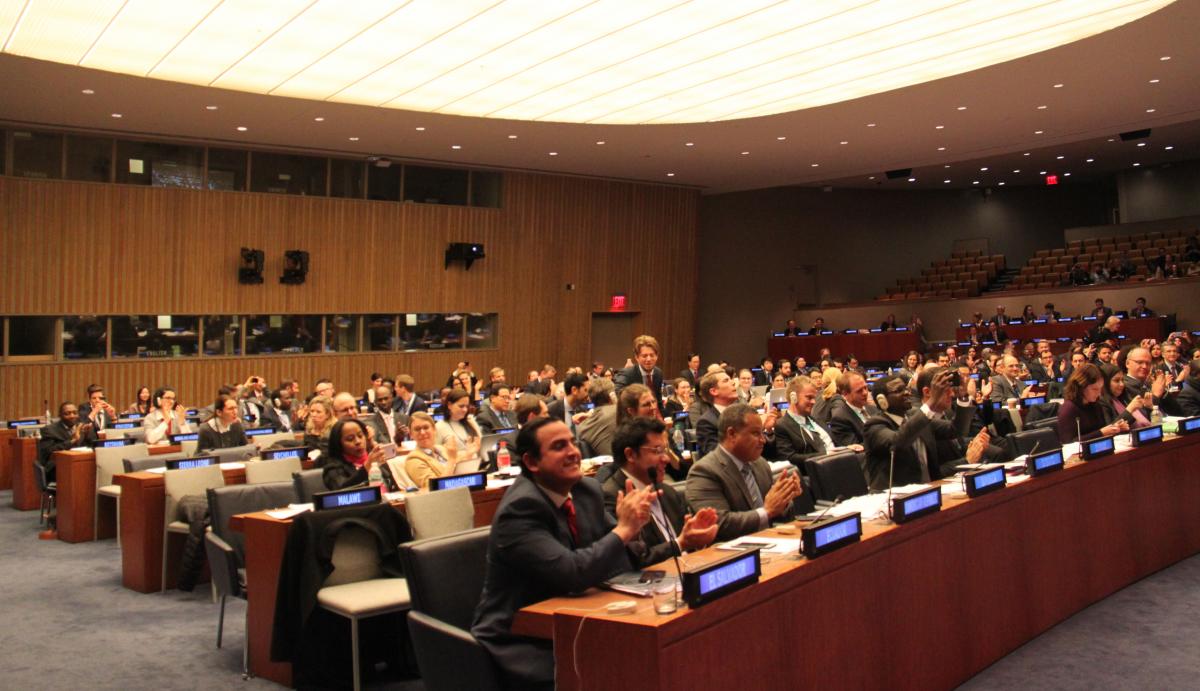
In the early hours of 15 December 2017 the International Criminal Court’s (ICC) Assembly of States Parties (ASP) at its 16th session adopted by consensus a resolution to activate the ICC’s jurisdiction over the crime of aggression with effect from 17 July 2018. With the ICC’s jurisdiction over the crime of aggression activating last week, we reflect on this historic outcome.
Crime of Aggression Amendments
When the Rome Statute was adopted in 1998, States were unable to agree on a definition of the crime of aggression or on how the ICC should exercise jurisdiction over the crime. As a compromise, the crime of aggression was listed in the Rome Statute, but States agreed that the crime would remain non-operational until it was defined and the conditions for the ICC’s exercise of jurisdiction were established. In 2010, at the Review Conference in Kampala, States Parties adopted amendments to the Rome Statute defining the crime of aggression and establishing the conditions for the ICC’s exercise of jurisdiction.
However the amendments did not themselves activate the ICC’s jurisdiction over the crime of aggression. Rather, they imposed two pre-conditions for this to occur: first, 30 or more States Parties were required to ratify or accept the amendments and second, the ASP was required to make a decision by a two-thirds majority to activate the ICC’s jurisdiction over the crime of aggression sometime after 1 January 2017. On 28 June 2016, the first condition was fulfilled. This meant that the 16th session of the ASP, being the ASP’s first meeting after 1 January 2017, had the potential to become part of international criminal law history.
Debate about Jurisdiction
However, prior to the 16th session of the ASP, there was much debate among both States and commentators about how the ICC’s jurisdiction over the crime of aggression would operate. The debate centred on whether, in cases of State referrals or where the Prosecutor initiated her own investigation (proprio motu), the ICC would have jurisdiction over acts of aggression committed by nationals or on the territory of States Parties to the Rome Statute which had not ratified the amendments. There were two competing legal interpretations: the broad view and the narrow view.
- According to the broad view, in cases of State referral or proprio motu investigation, the ICC would be able to exercise jurisdiction over an alleged act of aggression by a State Party that had not ratified the amendments (provided it had not lodged a declaration under Article 15 bis (4) of the amendments) on the territory of a State Party that had ratified the amendments.
- According to the narrow view, the ICC would not be able to exercise jurisdiction over an alleged act of aggression by a State Party that had not ratified the amendments regardless of whether the act involved a national or territory of a State Party that had ratified the amendments. A declaration under Article 15 bis (4) of the amendments by a State Party that had not ratified the amendments would not be necessary to exclude the Court’s jurisdiction.
Australia was one of a number of States that ascribed to the narrow view. Support for the narrow view derived primarily from the careful application of treaty law and the fundamental international law principle of State consent.
Negotiations at the ASP
This debate about jurisdiction continued at the ASP. Negotiations on the text of a resolution by which the ASP would activate the ICC’s jurisdiction over the crime of aggression were robust and intense. Ultimately, States Parties wanted three things: (i) activation of the crime of aggression at the 16th session, (ii) by consensus, and (iii) with the jurisdictional debate resolved in favour of their jurisdictional view.
The ASP is required under article 112(7) of the Rome Statute to make every effort to reach decisions by consensus. Many resolution drafts were proposed in an attempt to resolve or reach a compromise on the jurisdictional issue, but despite the valiant, creative and exhaustive efforts of the facilitator, none enjoyed consensus. Throughout the negotiations Australia underscored the importance of States Parties working together to seize this historic opportunity.
Resolution
Finally, in the early hours of 15 December 2017, the ASP adopted a Resolution by consensus activating the ICC’s jurisdiction over the crime of aggression and thus completing the Rome Statute project as originally envisaged. The activation resolution resolved the jurisdictional debate in favour of the narrow view of jurisdiction by confirming that, in cases of State referral or proprio motu investigation, the ICC shall not exercise its jurisdiction over a crime of aggression committed by a national or on the territory of a State Party that has not ratified the crime of aggression amendments. For those States that supported the broad view, it was necessary to compromise on jurisdiction in order to achieve activation by consensus.
The ICC’s jurisdiction over the crime of aggression took effect on 17 July 2018 making the ICC the first permanent international court with jurisdiction over this crime. 17 July 2018 was also the 20th anniversary of the Rome Statute’s adoption – both are milestones worth acknowledging.
Jesse Clarke is an Assistant Secretary and Sephora Sultana is an acting Senior Legal Officer in the Office of International Law at the Australian Attorney-General’s Department. Kate Smith is a Legal Officer in the International Law Branch of the Department of Foreign Affairs and Trade. All were members of Australia’s delegation to the 16th Session of the ASP.
 ICC Assembly of States Parties


