
What is the most effective, legitimate and coherent way to promote business respect for human rights and related state duties?
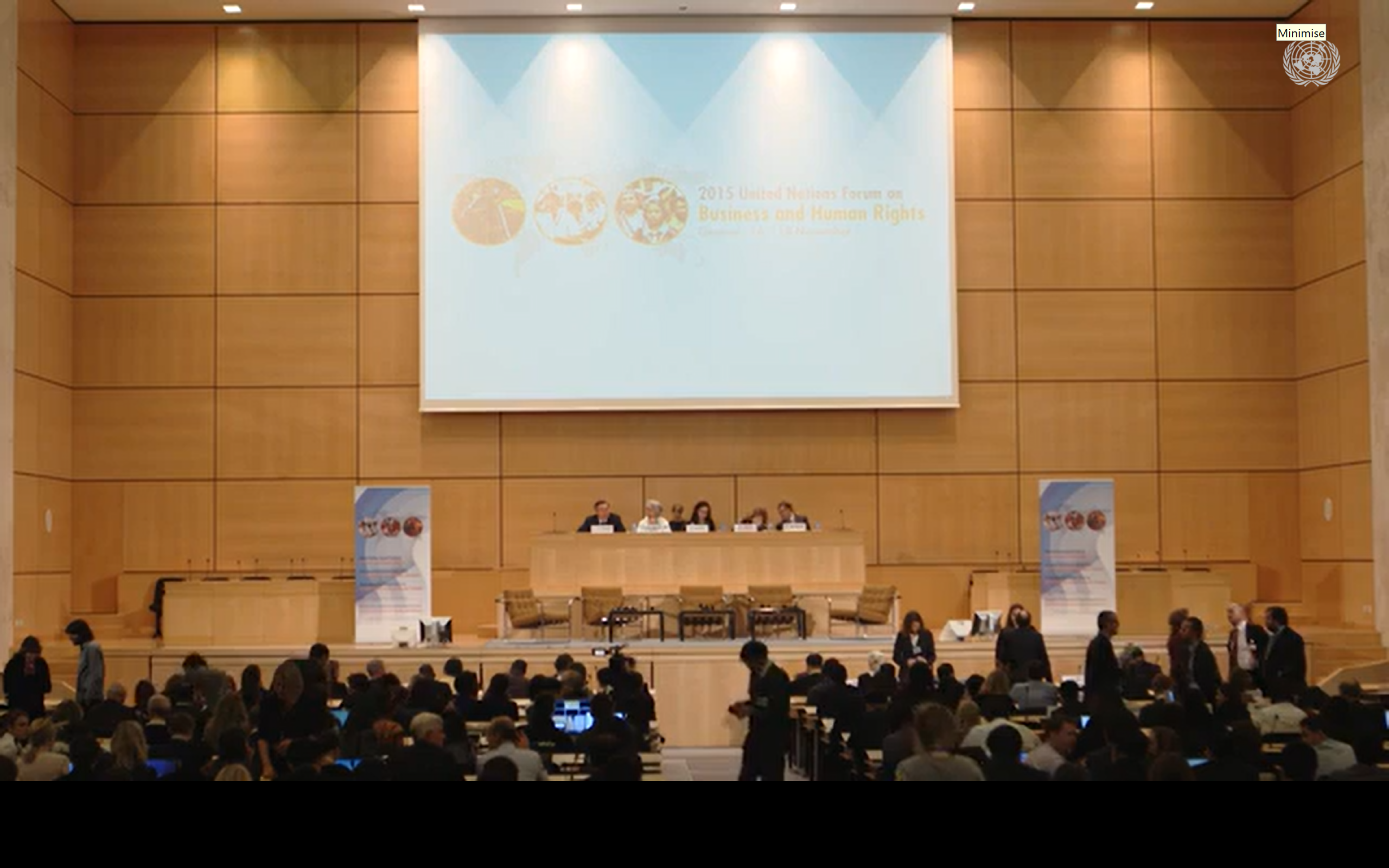
Last month saw the 4th Geneva UN Forum on Business and Human Rights. The UN Human Rights Council established the Forum to promote and share progress on the 2011 Guiding Principles (GPs) on operationalising the Council’s 2008 ‘protect, respect, remedy’ formula. This affirmed the state’s international legal duty to protect against and remedy human rights violations by third parties (including business enterprises), and business actors responsibility to respect human rights standards and facilitate remedies for their breach.
Whatever the Forum’s formal GPs-focused agenda, many participants were talking about the continued fallout from Council events in mid-2014. The GPs emphasise taking national-level legislative and other measures. Their unanimous adoption in 2011 amounted to states eschewing the idea of any new international instrument in this area. A treaty process was widely seen as, among other things, too complex, time-consuming and a distraction from national-level measures.
However, by 2014 consensus had frayed somewhat. The result was two parallel Council resolutions in June last year (available here). One called for continued progress on the GPs, including exploring the range of legal measures affecting access to remedy for business-related violations. A controversial resolution sponsored by some developing countries mandated the establishment of an ‘open-ended inter-governmental working group’ to pursue a binding legal instrument. Its first meeting was held in July.
What is the significance of this development? This commentary offers two points. The first is something of an aside. While this is an ANZSIL audience, arguably the business and human rights ‘project’ is not simply an international law (or even just public law) project. International legal mechanisms are only one means to the end of preventing and remedying business-related human rights violations. Indeed I argued in a recent Chatham House paper that much of the regulatory impact that matters in this area, at least in prevention terms, will probably come from a range of public, private and ‘hybrid’ governance sources. This partly reflects shifting expectations globally on the role of business in society. It also partly reflects commercial incentives, at least for some classes of larger firms and funds in some sectors, to address human rights risks. Meanwhile even if a widely-ratified convention were obtainable relatively easily and soon, it would not necessarily constitute an effective source of influence on business conduct and its regulation.
Nevertheless, for reasons both of principle and politics, the international law dimensions of the business and human rights project should and will remain highly significant.
This leads to my second point, on the treaty question: it is far from obvious what a viable treaty would add in this area, and not obvious that any value-adding treaty would be viable. Of course, a mandate towards a treaty negotiation process is afoot. While only 20 states supported the mandate, they did include the BRICS (less Brazil). Consequently some debate in this field is turning from ‘should there be any treaty process?’ to ‘what form could or should a treaty or treaties take?’ For example, this year the International Bar Association commissioned a white paper assessing some options. Yet it is too soon to say that the working group’s creation settles the question of ‘whether to treaty’, as if all that remains is to iron out its parameters. As ever there is a close relationship between the questions of whether a treaty is desirable, whether one is achievable, and what form it takes. Some form of international legalisation is possible over the next decade, perhaps a ‘precision instrument’ on discrete issues. Such an initiative will not necessarily come from this working group. Going on the low state turnout and ambitious content proposals at the working group’s first meeting, a negotiated generalised instrument via this route seems many painstaking years away. Moreover, Council members’ views may shift over time. For example, in July 2015 the Russian Federation (which in 2014 voted for the group’s creation) described the move towards a new legally binding document as “currently premature”. Certainly, the EU and others will be working to avoid further North-South polarization in the Council on this issue.
State action on operationalising the GPs is not necessarily incompatible with pre-treaty negotiations, the shadow of which may indirectly stimulate greater initiative by states and business actors. Yet there remains some force to the argument that the treaty process would carry opportunity costs, including distracting or displacing state action on implementing GPs-related measures. Those states behind the working group are not necessarily diligent about these, which require no treaty to act upon. Meanwhile, the working group faces significant hurdles dealing with very complex issues around the proposed instrument’s nature and scope. For one thing, its focus only on ‘transnational’ enterprises seems fairly unworkable. It remains a sticking point with OECD states that rightly observe that domestic firms are responsible for most business-related human rights abuses, at least by volume.
A concern to promote the prevention and remediation of business-related human rights abuses can reasonably lead one to oppose the treaty idea at this time. At very least, there are many reasons to doubt the viability or efficacy of many of the proposals circulating. For instance, Olivier de Schutter recently suggested that one option is a treaty simply clarifying the extent of the state duty in respect of violations by business actors. Yet this duty has been affirmed many times, including unanimously in the Council on this exact issue. Such an instrument might be easy to gain consensus on, but what would it add? If the instrument sought to make the state’s duty more demanding, for example on extraterritorial regulation of corporate abuses, far greater consensus would be required. In its purely declaratory form such an instrument might give the business and human rights project greater momentum, but not necessarily. Indeed a simple declaratory instrument might constitute nothing more than another ‘cascade of words’ reinforcing what ANU researchers diagnose as patterns of empty ritualism in the international human rights system.
Jolyon Ford re-joined ANZSIL in 2015 and is an Associate Professor at the ANU College of Law. In 2016 he will run a new online LLM course ‘Business, Human Rights and Corporate Responsibility’.
 UN Web TV


