
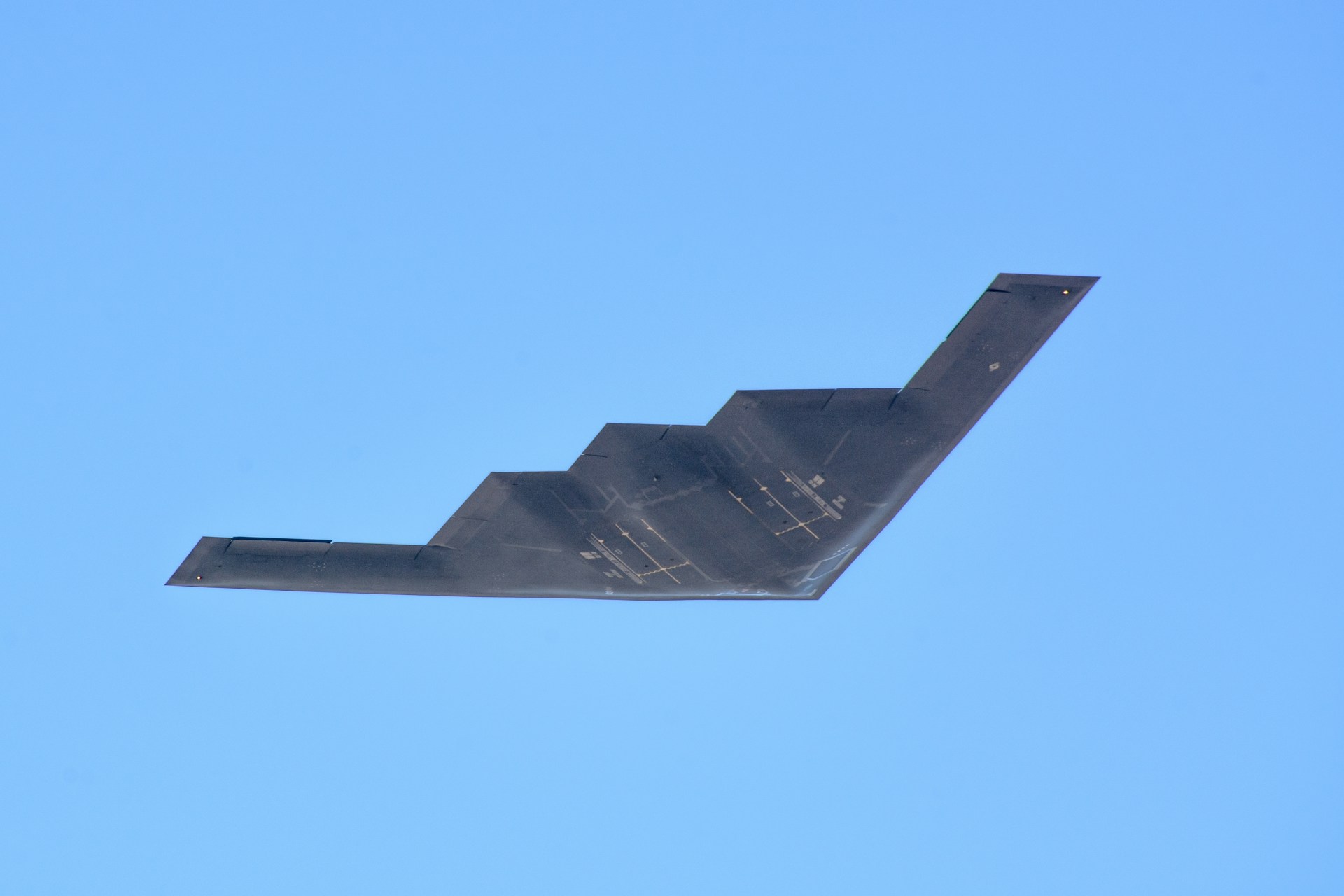
‘Fordow’ is the name of a village located in the mountainous Qom province in North-West Iran. It is also the site of a former nuclear enrichment plant which is likely to become familiar among students of international law. On the 22nd of June this year the US military targeted Fordow and other facilities at Natanz and Isfahan. These American operations were the latest example in an accelerating erosion of international legal constraints on states’ use of force. This decline carries implications for all states and one which should be of particular concern to the Australian Government.
*
Compliance with conditions which justify a modern ‘right to war’ or jus ad bellum is a familiar concept to lawyers and philosophers who study armed conflict amongst states.
Yet President Trump appeared untroubled by an obligation to observe certain international legal responsibilities prior to his recourse to arms. Nor was there a public post factum explanation of Administration reasoning over responsibilities prescribed within the United Nations Charter and embodied in relevant customary principles.
President Trump also seemed unconcerned by another matter. Trenchant critic Geoffrey Robertson KC wrote that the President had waged aggressive war and thereby committed ‘…the “supreme war crime” according to the judgement at Nuremberg.’ Eventual determination of that claim in a court of competent jurisdiction seems unlikely, although the evidence appears plausible in light of the President’s public conduct and elements of the offence to which Mr Robertson referred.
Very early in President Trump’s first term, Dr Chris Ward SC authored a short article in which he observed the President’s ‘overt hostility to international law as a system.’ In his second term the President has turned his polarising beliefs into policy far more effectively than during the somewhat fruitless bombast and grandiloquence of his first term. What should raise antipodean eyebrows is not that the President has chosen to act vigorously on at least some of his stated intentions. It is that when faced with a spectacularly fragmenting relationship, Canberra seems to have been slow to grasp the consequences of hurried approval of unilateral US bellicosity
*
Prior to the US strikes on Iran, the Australian Prime Minister and several prominent members of his government had been voluble supporters of what they and others called ‘the international rules-based order.’ In political rather than legal hands, this phrase tends to attract satisfyingly versatile imprecision. Regardless, some hours after the US operation, The Prime Minister uttered a brief statement of unequivocal support for the Americans. ‘The world has long agreed that Iran cannot be allowed to get a nuclear weapon. And we support action to prevent that. That is what this is.’
In hindsight one wonders if the Labor government decided that the US was too important an ally to permit a demonstration of continued adherence by Canberra to an admittedly dysfunctional, if at least ethically persuasive status quo ante on inter-state violence and threats of inflicting it. Nonetheless, a US perception of Australian misgivings over the bombings would probably have antagonised an infamously erratic President.
The problem here, in my view, is that the brief statement embodied a profound step: an unwitting encouragement for other states to discard (perhaps by degrees) treaty and customary prohibitions on the international use of force. In the same instant, Russian aggression against Ukraine remains lawlessly reprehensible. This hypocrisy is evident to friend and foe alike. And however unpalatable to some, it is also an example of developed world insincerity hastening disintegration of the post-World War II order to which much of the West professes steadfast allegiance.
Other states’ governments are now likely to work towards loosening constraints on their appetites for coercion by seeking to relax customary international law which accompanies Charter content, albeit unevenly. Given a little time, ambitious transgressors will probably take their cue to launch fresh threats of violence and acts of inter-state aggression. Should this happen in the next few years, these new belligerents will rely in part on the precedent of the US attack on Iran in 2025. A second and equally stout leg of argument will be the accommodating tolerance of that US recourse to force by Australian, British, French and German democracies .
In more general terms, the PM’s remarks were a blow to the normative value in restraint exercised by governments which from time to time contemplate inter-state threats and use of force. Reflexive or habitual diplomatic measures short of right-is-might savagery have been an integral part of the post-1945 international system. In the argot of UN drafters, this norm supported the ‘Pacific’ settlement of disputes described comprehensively at article 33(1) in Chapter VI of the Charter. A prospective decline in this institutional role is an unsettling factor to consider, as several states arguably slide towards multi-party armed conflicts – whether in Europe or Asia.
Aspects of Australian national security are also entangled in the decline to which our government has contributed. Several authoritarian states today enjoy influence over audiences far larger than their own captive constituencies. Chinese Communist Party (CCP) propaganda, intimidation and domestic subversion in Australia are established planks of grey-zone conflict. Clive Hamilton, Alex Joske and Peter Hartcher have written on the matter competently and at some length. In fairness, Canberra’s foreign interference legislation is evidence of some effort to find a remedy.
However, the loosening of customary constraints on threats or use of force accompanied by a weakened UN Charter will be of practical benefit to the CCP. Consider how the Party has profited from growing expansion in CCP influence over inter-governmental organisations[1] especially UN organs and specialised agencies; poor faith in bilateral treaty negotiations with Canberra; and CCP collaboration with transnational organised crime[2] in the commission of internationally wrongful acts for which the People’s Republic of China (PRC) is responsible.
A closely related problem which Mr Albanese’s government has exacerbated arises from human imagination. President Trump’s repeated threats to invade Greenland, Canada, Gaza and Panama are not necessarily examples of confected hyperbole. The perceptive Yale lawyer Oona Hathaway remarked that ‘Even raising the possibility of these clearly illegal actions does harm to the international norm, because it makes them thinkable.’ Perhaps unsurprisingly, her comment may stimulate leaders in the familiar autocracies. But their number is likely to be swelled by intolerant populists now flourishing in illiberal democracies. They too, may be animated by the prospect of reward for conduct which attracts bearable costs (as they may see it) in relation to the benefits to be gained.
On an individual level, one might also consider current diplomatic efforts to impose counter-measures like ‘Magnitsky’ style acts drafted to disrupt the lives of individual despots and their associates, some of whom invade states without legal justification. Civilised attempts at penalising delinquents seem likely to evaporate in a newly unfettered climate of pervasive threats, counter-threats and violence. Worse, the ostracised villains of today may re-invent themselves tomorrow to become Canberra’s new partners of easy convenience. In that world, normative judgements which accompanied greater restraint will become memories of another era.
*
Canberra is not short of analysts, consultants, theorists and advisers to whom Mr Albanese’s remarks were viewed as a necessary act of Realpolitik. Some of these public servants see a limited role for international law in matters of inter-state violence; and particularly where the exercise of American brute force compels the leader of an increasingly vulnerable ally to demonstrate loyalty without delay. To these realists, Labor support for the US attacks on Iran was a necessary obligation springing from compelling reasons of state or raisons d’état.
They have a point.
Yet it would be instructive to point out that in early 2003 Mr Albanese and Ms Wong both opposed the invasion of Iraq by US President George W. Bush. At that time Mr Bush defied the UN Security Council; claimed there was a genuinely imminent threat to the US from Iraq where none existed; advocated ‘preventive’ wars of regime change and adopted an expanded ‘pre-emptive’ self-defence test to justify the US invasion. These acts were met with consternation and public rejection by forty-three Australian international law practitioners and academics. However, the view from government benches in Canberra in 2025 differs considerably from the opposition seats in 2003.
Although a replacement for the post-World War II order is not yet clear, the tenor of transitional disorder is making itself felt. Irrespective of what happens next in the Middle East, shudders of continuing violence in Ukraine and elsewhere presage a new era of hard power. Or perhaps not. It may be more accurate to suggest that a recognisable, older era has made an unwelcome return. The prior high-water mark for states’ prerogative to wage war with very few constraints extended from nineteenth century ‘spheres of influence’ to the carnage of 1918. Plenty of educated observers fret that our 21st century may easily turn in a similarly deadly direction. Nor is there is any shortage of escalating threats. The top few are likely to include instability arising from a further US retreat from international responsibilities, the ubiquity of catastrophic climate change and the intentions of the Chinese Communist Party. Or all three at once.
A hardy pessimist may nonetheless point out some constructive choices. If the UN system of institutional restraint of armed conflict continues to decline, recognition of this implies a corollary which is startlingly simple: a need to plan for more frequent and more destructive inter-state violence. In that scenario, changes to customary international law on the use of force seem likely to widen the scope of sovereign states’ prerogatives and reduce the influence of international institutions and earlier norms on the threat or use of force.
[1] Malcolm H Patterson, ‘How China Abuses Pacts with International Agencies’ (2022) 587 Quadrant 17.
[2] Malcolm H Patterson, ‘International Law, Organised Crime and the Chinese Communist Party’ (2022)(93)1 Australian Quarterly 24.

Malcolm Hugh Patterson
Dr Malcolm Hugh Patterson graduated from the University of New South Wales with an hons BA in history, a first-class hons MA in international relations, a graduate law degree and first-class hons LLM in international law. He holds an inter-disciplinary PhD from the University of Cambridge (2008) and is admitted to practice law in the Supreme Court of NSW and the High Court of Australia. He also holds diplomas in financial markets, legal practice and company direction. His dissertation was the basis of Privatising Peace (Palgrave Macmillan 2009). Dr Patterson was joint editor and contributor to Contractors and War (Stanford University Press 2012). He has written academic book and journal chapters on UN peacekeeping, the law of armed conflict and the arms trade; lectured on international relations at the University of New South Wales in 2008 and the Macquarie University ‘Global Leadership Program’ over 2010-14; then taught public international law on a sessional basis at Macquarie University Division of Law over 2015-19. He is an independent international law and international relations researcher.



