
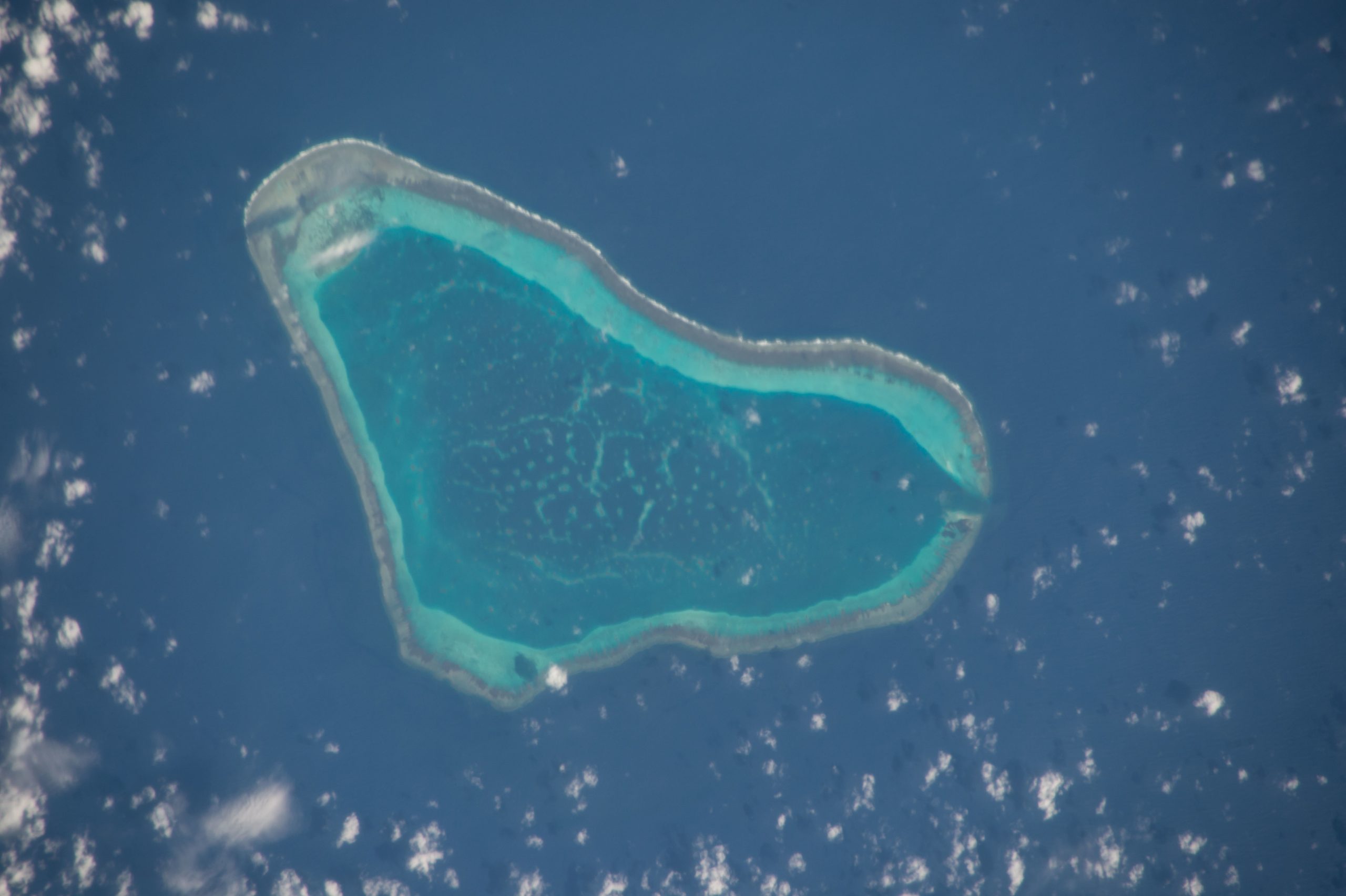
On 12 July 2016, the Arbitral Tribunal in the recent arbitration between the Philippines and China (the South China Sea Arbitration) handed down its long-awaited Final Award (see also its Press Release). This arbitration concerned the role of historic rights and the source of maritime entitlements in the South China Sea, the status of certain maritime features and the maritime entitlements they are capable of generating, and the lawfulness of certain actions by China that were alleged by the Philippines to violate the United Nations Convention on the Law of the Sea (UNCLOS).
The award finally elucidated one of the long-standing perplexities of UNCLOS – what is a rock? A key aspect of the decision was whether certain features in the South China Sea were low-tide elevations, rocks or islands. The Tribunal determined that the contested features that were above water at high tide (Scarborough Shoal, Gaven Reef (North), McKennan Reef, Johnson Reef, Cuarteron Reef and Fiery Cross Reef) were rocks, not islands. These legal definitions matter because the status of a feature determines what rights a State can claim around those features and the extent of those rights.
To determine the status of different features, the Tribunal had cause to interpret Article 121 of UNCLOS, which provides:
- An island is a naturally formed area of land, surrounded by water, which is above water at high tide.
- Except as provided for in paragraph 3, the territorial sea, the contiguous zone, the exclusive economic zone and the continental shelf of an island are determined in accordance with the provisions of this Convention applicable to other land territory.
- Rocks which cannot sustain human habitation or economic life of their own shall have no exclusive economic zone or continental shelf.
Although opportunities have previously been presented to international courts and tribunals to consider the definition of rocks and islands,1 Philippines v China reflects the first full examination of the potential meaning of this provision, and especially Article 121(3).
In its interpretation of Article 121(3), the Tribunal considered that ‘if a feature is entirely barren of vegetation and lacks drinkable water and the foodstuffs necessary even for basic survival’ ([548]), it is most likely a rock because it cannot sustain human habitation. Economic activity that is entirely dependent on external resources or devoted to extractive activities without the involvement of a local population is also indicative of a rock rather than an island since it does not have an economic life of its own ([543]).
The land reclamation efforts of China, which have greatly increased the size, habitability and use of different features, made no difference in this assessment. The Tribunal looked to the ‘earlier, natural condition, prior to the onset of significant human modification’ ([511]). Once a rock, always a rock.
One of the most controversial findings on the status of different high-tide features was that Itu Aba, also known as Taiping Island, was a rock. The Tribunal examined evidence to find that there was ‘historical evidence of potable water…[;] naturally occurring vegetation capable of providing shelter and the possibility of… food resources [and] small numbers of fishermen… historically…present’ ([615]).’ Yet ‘with features that fall close to the line in terms of their capacity to sustain human habitation’, the Tribunal considered it had to look beyond physical characteristics to historical evidence of human habitation and economic life ([616]). In doing so, Itu Aba could not be considered an island, especially when the human presence was done to bolster sovereignty claims and was largely dependent on outside supply ([620]).
A key driving force in the Tribunal’s discussion was the view that tiny land features should not be used to generate expansive maritime claims, and particularly not generate Exclusive Economic Zones and continental shelves. ‘Article 121(3) was intended to prevent such developments and to forestall a provocative and counterproductive effort to manufacture entitlements ([621]).’
The decision is only strictly binding on the Philippines and China, but the interpretation of Article 121(3) will no doubt be carefully examined by all other Parties (or potential Parties) to UNCLOS. Do the maritime claims off features such as Johnston Atoll (US), Kerguelen Islands (France), Heard and McDonald Islands (Australia) and Okinotorishima (Japan) need to be reassessed?
Japan’s claims to a continental shelf and an Exclusive Economic Zone off Okinotorishima have been protested by China, Taiwan and Korea. Okinotorishima is roughly half way between Taiwan and Guam. Japan was reported to have dedicated 13 billion yen this year for the purpose of rebuilding it after storm damage and has also sought to re-establish the coral reef and build concrete embankments. But in accordance with Philippines v China, this cannot change its legal status into an island.
Unlike Japan, Australia would be able to note that other States have not protested its maritime claims around Heard and McDonald Islands.2 Most notably, no protests were lodged when Australia claimed an outer continental shelf, which permits a further claim to exclusive seabed rights beyond 200 miles.3 This claim was assessed by the Commission on the Limits of the Continental Shelf in accordance with article 76 of UNCLOS, and Australia proclaimed without challenge an outer continental shelf around the Heard and McDonald Islands on the basis of the Commission’s recommendations. Article 76(8) provides that this declaration is now ‘final and binding’.
The same level of acquiescence has not been true for China and Japan. Each has faced objections to claims to extended maritime zones generated by ‘rocks’. The Tribunal’s decision means that China may no longer do so. It remains to be seen whether the same will hold true for other States.
1 For example, Ukraine and Romania contested the status of Serpent (or Snake) Island in the context of their maritime boundary delimitation dispute, but the International Court of Justice refrained from resolving this issue as it did not consider that the island affected the overall maritime entitlements generated from the mainland coasts. See Maritime Delimitation in the Black Sea (Romania v Ukraine) [185]–[187].
2 In the Volga prompt release case (23 December 2002), Judge Vukas commented that he did not believe that the Heard and McDonald Islands were entitled to an EEZ or continental shelf as they constituted ‘rocks’. His reasoning was similarly based on the object and purpose of Article 121(3) as articulated by the Philippines v China Tribunal. However, the obiter of a single judge is not equivalent to the position of a State that may potentially negate a claim of acquiescence.
3 By contrast, protests were lodged in relation to Australia’s future claims for extended continental shelf allocations off the Australian Antarctic Territory. See Donald R Rothwell and Tim Stephens, The International Law of the Sea (Hart, 2nd ed, 2016) 119.
Professor Natalie Klein is Professor and Dean at Macquarie Law School. She teaches and researches in different areas of international law, with a focus on law of the sea and international dispute settlement. Professor Klein is the author of Dispute Settlement and the UN Convention on the Law of the Sea (Cambridge University Press, 2005) and Maritime Security and the Law of the Sea (Oxford University Press, 2011). She provides advice, undertakes consultancies, and interacts with the media on law of the sea issues. Prior to joining Macquarie, Professor Klein worked in the international litigation and arbitration practice of Debevoise & Plimpton LLP, served as counsel to the Government of Eritrea (1998–2002), and was a consultant in the Office of Legal Affairs at the United Nations. Her masters and doctorate in law were earned at Yale Law School. In 2013, she was invited to become a Fellow of the Australian Academy of Law.
 Photo by Earth Science and Remote Sensing Unit, Lyndon B Johnson Space Center


