
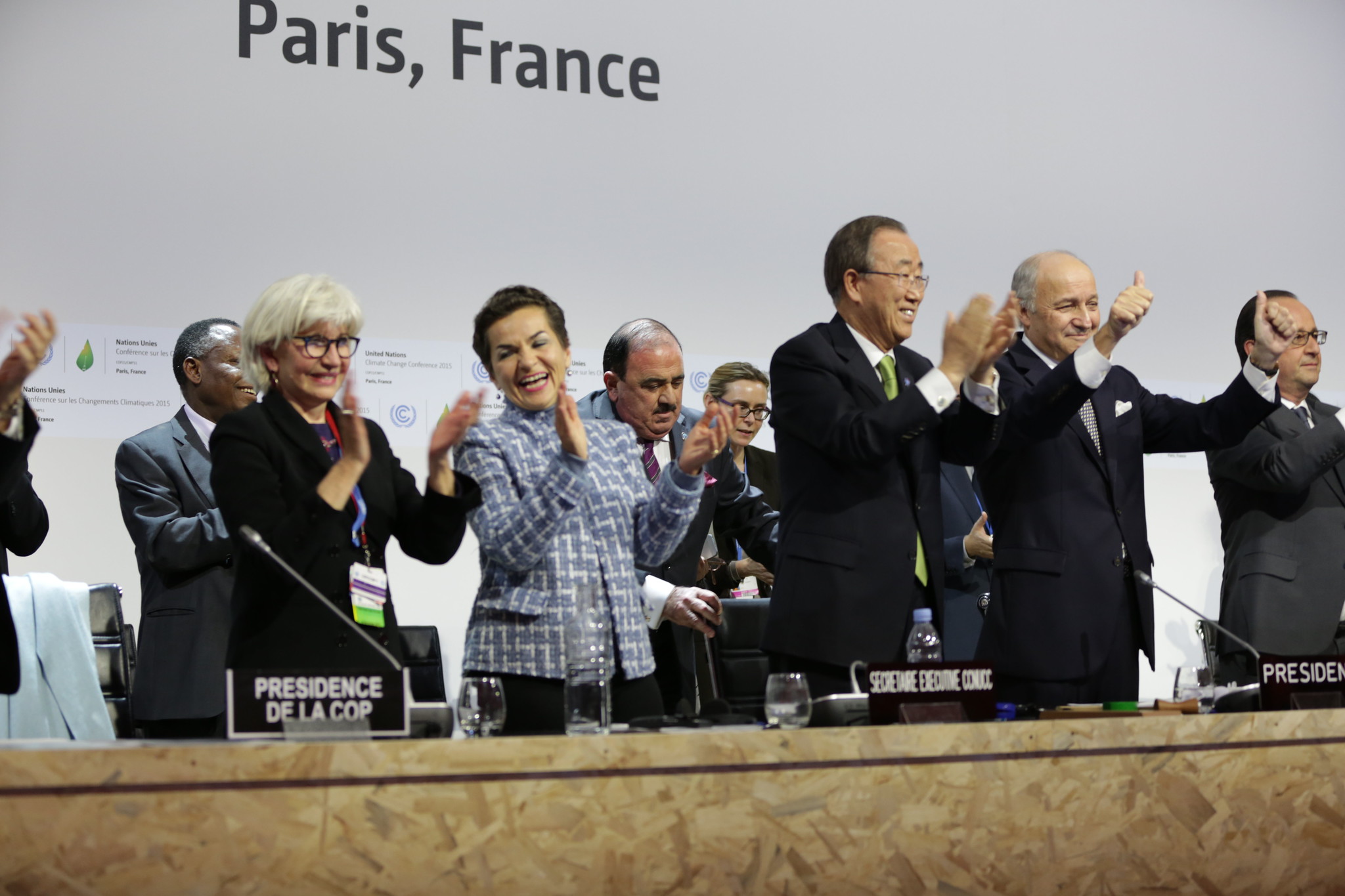
There has been a notable shift in international environmental law towards broad and shallow instruments. These instruments have broad participation but minimal substantive obligations; they prize broad participation at the price of effectiveness. The 2015 Paris Climate Agreement, the Sustainable Development Goals and the 2016 Carbon Offsetting and Reduction Scheme for International Aviation under the International Civil Aviation Organization (ICAO) all embody this type of instrument.
The shift is predictable given the predominance of consensus decision-making processes and the current paradigm. It is current conventional wisdom that global problems require global solutions. Yet this conventional wisdom runs against the history of successful international agreements, which tend to start narrow and broaden over time. Examples include the 1987 Montreal Protocol on Substances that Deplete the Ozone Layer and the World Trade Organisation Agreements, which started out with very few Parties but are now widely ratified.
The new overriding prioritisation of universal participation can explain the approach and the weaknesses of the Paris Agreement. Structurally, the Paris Agreement is a pledge and review system which operates by five year cycles. It is a global show-and-tell regime in which countries put forward new pledges which are collectively reviewed as part of a ‘global stocktake’.
Although the Paris Agreement is a treaty for the purposes of the Vienna Convention on the Law of Treaties, its legal obligations are minimal, procedural, ambiguous and difficult to enforce. For developed country Parties, they are often obligations that they already fulfil. For example, the only substantive and additional legal obligations for Australia are to ‘prepare, communicate and maintain’ a pledge (a Nationally Determined Contribution or ‘NDC’, article 4.2), ‘pursue domestic measures’ to meet said pledge (article 4.2) and ensure that future pledges are ‘a progression beyond existing efforts’ (article 4.3). Such obligations are unhelpfully ambiguous. For instance, ‘progression’ is not defined: a minor increase in climate finance could potentially be defended as a progression of national efforts. Pursuing domestic measures to meet a pledge could be justified by a range of minimal and ineffective national climate policies.
There are a small number of other obligations, such as to support pledges with ‘appropriate accounting measures’ (article 4.13) and to maintain a national greenhouse gas inventory (article 13.7). However, these are obligations that developed countries such as Australia already meet, because they are core commitments under the 1992 United Nations Framework Convention on Climate Change.
This framework of loose procedural obligations was a necessary design feature to attain universal participation. For the United States to participate without Senate approval, the Paris Agreement had to fall under the mandate of the President to enact a sole-executive agreement. This meant that legal obligations on mitigation targets and financing were off the table. To appeal to China and India, obligations on reporting, monitoring and verification, as well as the parameters of pledges needed to be watered down. Given the inadequacy of existing pledges and the weakness of the obligations and structure, the Paris Agreement has instead been justified and defended by academic and political commentators through ratcheting mechanisms: different ways to encourage improved action over time.
The Paris Agreement’s success will rely on both peer and public pressure through the transparency framework and regular reviews, as well as the novel concept of sending a ‘market message’ or investment ‘signal’ (the idea that the Paris Agreement produces a signal to the economic world that a low-carbon future is inevitable). This was expressed in a post-Paris Agreement op-ed in the Economist: ‘after Paris, the belief that governments are going to stay the course on their stated green strategies will feel a bit better founded—and the idea of investing in a coal mine will seem more risky.’
Both mechanisms need universal (or close to universal) membership to be effective. A free-riding major emitter undermines the ability to exert political pressure. The legitimacy of regulatory certainty for investment requires broadly held goals and norms. The problem is that there is scant empirical evidence that suggests either of these mechanisms will work. Using pledge and review systems as a peer pressure mechanism has a chequered history and has only worked in rare cases such as the World Health Organization’s Tuberculosis Framework. Strong pressure is unlikely under the Paris Agreement architecture given that the global stocktake process is only for collective efforts—it is not intended to critically and publically examine individual country performance. Outside of trade, there is also little research on how international law affect investment patterns, particularly for the loose and largely unenforceable approach of the Paris Agreement. It is questionable whether investors will place much faith in long-term international goals which are not underpinned by ambitious or enforceable national pledges.
Ratification of the Paris Agreement will likely be close to universal, but this has come at the cost of effectiveness. The Paris Agreement relies on the participation of all major emitters and has little to offer without it. This means that the agreement is fragile. The recalcitrance of a major emitter could undermine the political pressure mechanisms and any potential investment signal. Unfortunately, neither pressure nor a hypothesised market signal are likely to sway the actions of either free-riding States or potential non-Parties. A global gamble with a broad and shallow agreement could simply lead to an outcome that is universal but ultimately useless.
Dr Luke Kemp is a lecturer in climate and environmental policy at both the Fenner School of Environment and Society and Crawford School of Public Policy at the Australian National University (ANU), and a Senior Economist with Vivid Economics. He holds both a Doctorate in Political Science (2016) and a Bachelor of Interdisciplinary Studies with first class honours from the ANU (2011). He is an expert in international climate policy, having advised Australian parliament on the ratification of the Paris Agreement in 2016. He is also a regular media commentator with the Conversation and his research has been covered by international outlets such as the Washington Post.
 UN Climate Change/James Dowson



