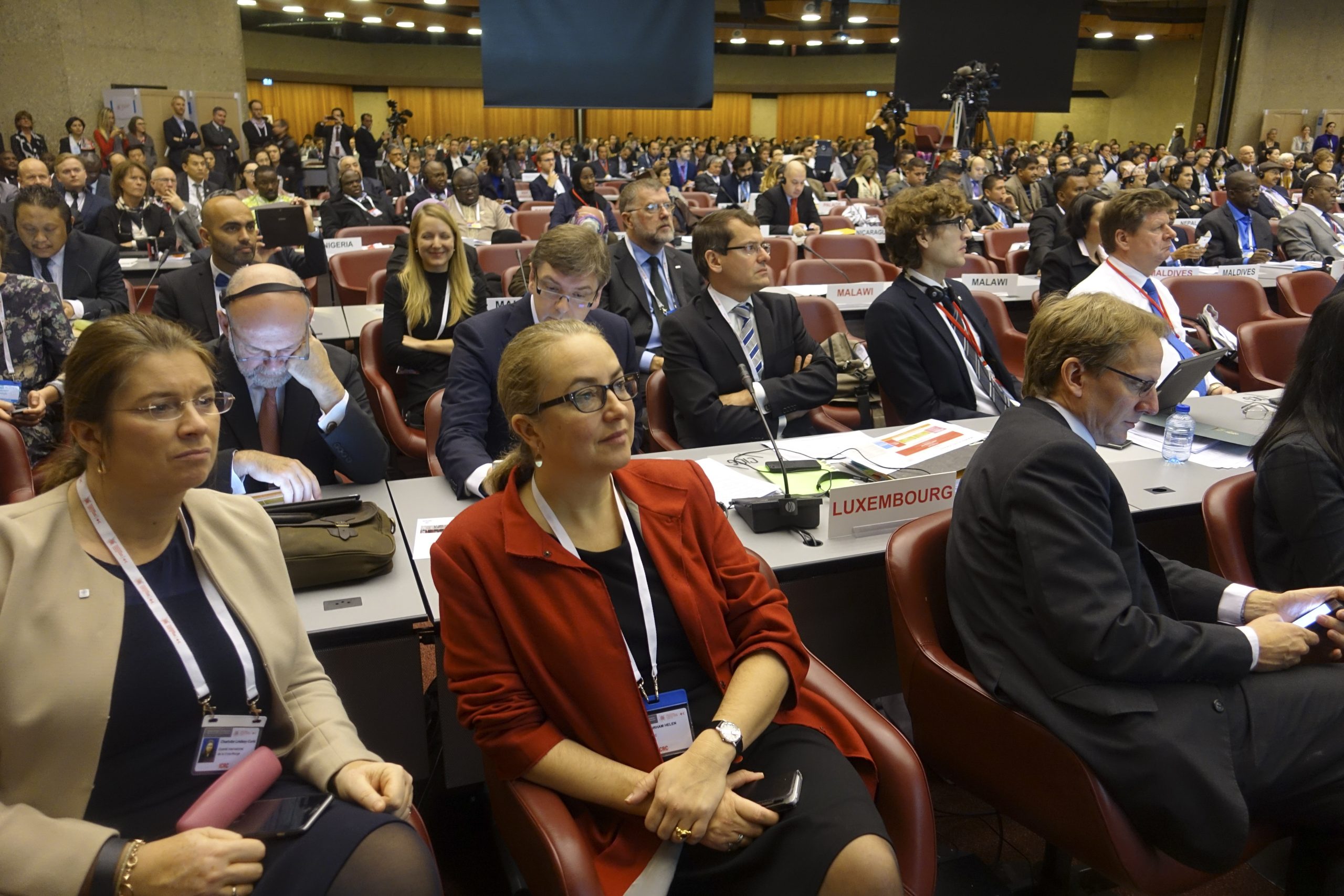
The 32nd International Conference of the Red Cross and Red Crescent was held in Geneva from 8-10 December 2015. The International Conference is a unique forum bringing together the world’s largest humanitarian network and nearly every government. It is the supreme deliberative body for the Red Cross and Red Crescent Movement where representatives of all components of the Movement — National Societies, the International Committee of the Red Cross (ICRC), and the International Federation of the Red Cross and Red Crescent Societies (IFRC) gather with States to “examine and decide upon humanitarian matters of common interest and any other related matter” in accordance with Article 8 of the Statutes of the Movement. In attendance last month were 185 National Societies, ICRC, IFRC, 169 States, and a number of observers including UN organisations.
In the 50th anniversary year of the Fundamental Principles that guide the Movement, the International Conference focussed on the utility and relevance of the Fundamental Principles, contemporary challenges in international humanitarian law (IHL), action on the prevention of and response to sexual and gender based violence in both armed conflict and other emergencies, increasing concerns regarding health care in danger, and building resilience and strengthening legal frameworks for disaster risk reduction and response.
One of the key functions of the conference is to contribute to the unity of the Movement and to the achievement of its mission in full respect of the Fundamental Principles. Another function is “to contribute to the respect for and development of international humanitarian law and other international conventions of particular interest to the Movement”, and at this Conference there were two resolutions of particular interest in that regard.
The first was a resolution looking at strengthening international humanitarian law protecting persons deprived of their liberty. This followed on from Resolution 1 at the 31st International Conference which asked the ICRC to explore how the law could be strengthened with regard to persons deprived of their liberty. At the outset, the ICRC acknowledged that current humanitarian protections provided for persons deprived of their liberty in international armed conflict (IAC) are far-reaching and do not call for urgent action. In contrast, the protections for persons deprived of their liberty in non-international armed conflict (NIAC) are far less extensive. Four specific areas of concern were identified as areas of focus for the consultation process. These included conditions of detention, particularly vulnerable detainees, grounds and procedures for internment, and detainee transfers.
While the ICRC’s view is that the negotiation and adoption of a binding international treaty – or an amendment to an existing one – would be the most effective way of strengthening IHL in this area, States made clear in the consultation process that preceded the international conference that they have little appetite at this stage for the creation of new international law. Instead, States have agreed to continue to work to strengthen IHL protections while ensuring that IHL remains practical and relevant to protecting persons deprived of their liberty in relation to armed conflict, in particular in relation to NIAC. The resolution as adopted leaves open the possibility of the adoption of non-legally binding outcomes, although the nature of any such outcomes remain a matter for further negotiation.
The second resolution of interest, Strengthening Compliance with International Humanitarian Law, was a result of four years of State consultations facilitated by the ICRC and the Swiss Government, following an invitation to the ICRC in Resolution 1 of the 31st International Conference to propose a range of options and recommendations to enhance and strengthen compliance with IHL. The resolution proceeded on the basis that the existing mechanisms of compliance with IHL, namely the Protecting Powers mechanism, the Enquiry Procedure and the International Humanitarian Fact-Finding Commission, have rarely, if ever, been used and in any event apply only to situations of IAC and not to NIAC. A number of guiding principles for the consultation process were developed and it was agreed that these guiding principles should underpin any outcome that may be adopted at the 32nd International Conference. Among other things the guiding principles provide that any IHL compliance system would need to be effective, avoid politicisation, be State-driven and consensus-based, avoid duplication, be based on dialogue and cooperation, and be voluntary i.e. non-legally binding.
The resolution presented to the Conference proposed a number of measures that had been reflected in the consultation process, including:
- A desire by States to establish an effective, voluntary, non politicised forum where States could meet regularly to exchange views on issues related to strengthening respect for IHL. It was proposed that this forum could be called a Meeting of States on International Humanitarian Law (Meeting of States).
- The Meeting of States should have two functions: regular thematic discussions on IHL issues, and periodic reporting on national compliance with IHL. It was proposed that these voluntary functions should non-contextual and non-politicized.
- Potential administrative arrangements for the Meeting of States were suggested, including participation by components of the Movement, including national Red Cross and Red Crescent societies as observers.
Many States supported the resolution while recognising that it represented a compromise on the concepts that had been discussed in the consultations. Australian Red Cross made a strong statement in the Drafting Commission on behalf of 28 National Societies supporting the resolution and in particular recognition of the roles and mandates of National Red Cross and Red Crescent Societies in the field of IHL.
However, it very soon became clear that the proposed Meeting of States was not universally endorsed. While all States could agree that they supported enhancing and strengthening compliance with IHL there was a divergence of views how that could best be achieved. There was significant opposition to the creation of a new compliance mechanism, and strong voices preferred to work to strengthen existing mechanisms, including confidential consultations with ICRC, regional IHL forums, and the International Conference itself.
In the end a significantly watered down resolution was adopted thanking Switzerland and the ICRC for their work on the consultation process, endorsing the guiding principles, and recommending “the continuation of a State driven intergovernmental process, based on the principle of consensus, … to find agreement on features and functions of a potential forum of States, and to find ways to enhance the implementation of IHL using the potential of the International Conference, and IHL regional forums”. The outcome of this consultation process will be reported back to the 33rd International Conference in 2019.
In response to the lack of support for the resolution ICRC President said “International humanitarian law is flouted almost every day, in every conflict around the world. By failing to support this initiative, States missed an opportunity to help to protect millions of people.” While the resolution is not what was hoped, there is room for optimism. What remains is reaffirmation by States that compliance with, and strengthening of, IHL must remain a priority in order to provide protection and assistance for the victims of armed conflict. Consultations in the coming years will need to focus on addressing the differing views expressed at the International Conference, and arriving at a consensus on the best modality for enhancing compliance with IHL for the future.
About the author: Dr Phoebe Wynn-Pope is the Director of International Humanitarian Law and Movement Relations for Australian Red Cross. The author would like to thank Geoff Skillen, Chair of that National IHL Committee and member of the Drafting Committee at the 32nd International Conference for his assistance in preparing this article.
 IFRC / ICRC